Showing posts with label Rainforest Animals. Show all posts

Saturday, February 26, 2011

Malaysian Elephants

Rainforest Animals Wild Malaysian Elephants

Malaysian Elephants in Peninsular Malaysia are in same species of Asian Elephant (Elephas Maximus) while its siblings in Sabah Borneo Malaysia is a little bit smaller in size and known as Sabah Pygmy Elephants (Elephas maximus borneensis). Asian Elephants of Peninsular Malaysia, Thailand, Myanmar and India (Mainland Asia Continent) share same characteristic and categorised as Elephas Maximus, other recognized sub categories  are Sumatran Elephants ( Elephas maximus sumatrensis),  Sabah Borneo Pygmy Elephants (Elephas maximus borneensis) and Sri Lankan  Elephants (Elephas Maximus Maximus). Elephants on these islands of Borneo, Sumatra and Sri Langka have distinct characteristic from Asian Elephants and may have seperated from mainland in hundred thousand years ago.  Malaysian elephant or Asian Elephants are much smaller than African Elephants and have distinct different of smaller ear that have staright shape at the bottom. Population of wild Malaysian Elephants in peninsular Malaysia can be found left scattered in isolated forest reserves. Deforestation of Malaysian Rainforest , construction of electrical hydro dam, clearing up of rainforest for plantation and development have cause fragmentation of rainforest and reduce suitable habitat for Malaysian Elephants.  
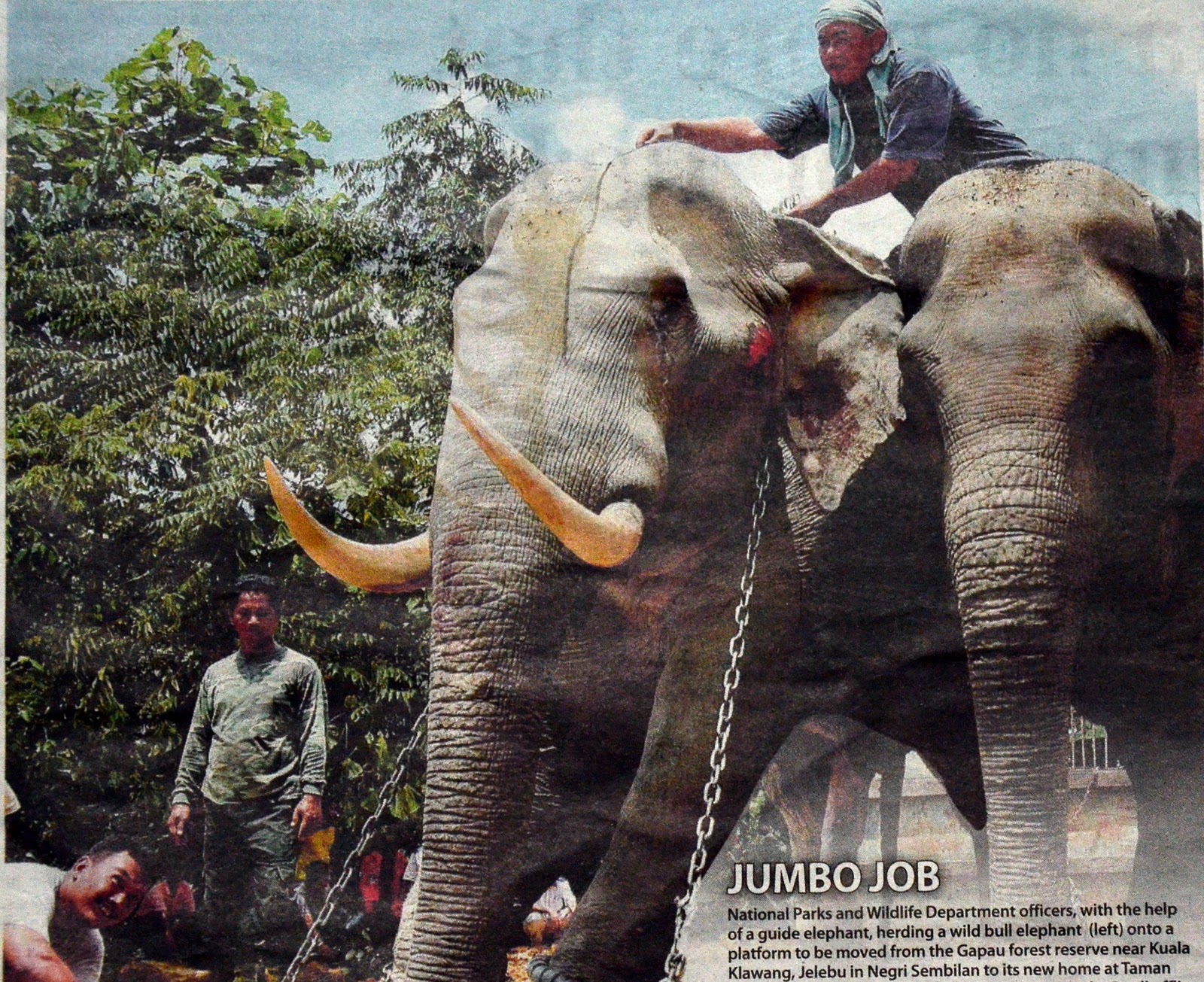


Wild Malaysian Elephant being transfered to National Park after encroaching into Plantation

Habitat and Diet of Malaysian Elephant
Malaysia Elephants natural habitat is in lowland rainforest below 300m  sea level. Elephant is attracted to moonlight and love to see view of landscape from higher place and It is well known for Malaysian Elephants to climb up to peak of Mountain such as Bintang Mountain, Chamah and Ulu Sepat Mountains in Peninsular Malaysia. Aluminium panels that erected on these peaks used to be uprooted by Malaysian Elephants because it is reflective and attract Elephants' attention. Even with its big size, do not suprise that Elephants could climb with ease. Malaysian Elephants need vast area of lowland rainforest to meet its need for foods and ample space for it to roam, live and breed. Malaysia Elephants are forest herbivores. One adult can eat up to 150 kg of vegetation per day, feeding mostly on species of palms, grasses and wild bananas. In Malaysia Peninsular, Malaysian Elephants can be found in forest reserves around Bintang Mountain Range, Titiwangsa Mountain Range (concentrated especially on the northern forest reserve such as Grik, and Temenggor) , Tahan Mountain Range that lies in Taman Negara National Park (Most of its roam in the area of Tasik Kenyir border and Kuala Tahan / Jerantut), Endau Rompin National Park at south of Malaysia Peninsular and Gapau Forest Reserve in Kuala Klawang Negeri Sembilan. While Sabah Pygmy Elephants largely found in Kinabatangan Valley of Sabah Rainforest.

Ecology of Malaysian Elephants

Social Structure Elephant’s societies are matriarchal, led by a female in small groups. Family groups consist of mothers, daughters, sisters and immature males. An adult male usually remain solitary while sometime join with main herd which is essential for their reproduction and survival. Asian and Malaysian Elephant could live for up to 60 to 80 years. One calf is born at a time and female Asian elephants have about 7 calves in a lifetime. They give birth about every 4 - 6 years and gestation / pregnancy period is between 19-22 months and Elephants Calves suckle for 3 - 4 years. Elephants have very good sense of awareness of its surrounding and good memory. Elephant that is protecting its cub and mating would be very aggressive. Defensive measure should not be taken lightly when entering Elephants area, hikers normally use firecracker to give warning or simply to let the Elephants know that human is in the area thus avoid direct encounter.


Conservation and Sanctuary
Depleted lowland rainforest has draw more encounter between Malaysian Elephants and human. This has become inevitable as human plantation and development has encroaching more and more on elephants habitat thus create human-elephants conflict.  Malaysian Authority has come with several applauble measure such as setting up of Kuala Gandah Elephant Santuactry at Temerloh Pahang through its Wildlife Agency , and Gazetted of several Forest Reserves through out Malaysia. This sanctuary is the only center in Malaysia dedicated to locating, subduing, translucent problem Malaysian Elephants from areas where their habitats are constantly being encroached by plantations, to Malaysia's National Parks such as Taman Negara. This sanctuary also shelter orphan elephant that got separated from its herd and injured elephants. The Role of this sanctuary is essential in managing and controlling the increasing human-elephants conflict that sometime reported in newspaper. Visiting Kuala Gandah Elephant Sanctuary is fun which you have opportunity to get close and personal with these Malaysian Elephants.  

Sabah Pygmy Elephants - from WWF Malaysia

Related Articles:

Sunday, February 13, 2011

Sumatran Rhino

Pregnant rare rainforest animal - Sumatran Rhino spotted in Borneo


KOTA KINABALU: Wildlife experts here remain hopeful about the future of the highly endangered Sumatran rhino following a rare picture of a 20-year-old female that is believed to be pregnant.
The picture of the female sumatran rhino was captured by remote camera trap devices set up jointly by the Sabah Wildlife Department and WWF-Malaysia.
The picture was considered rare as there were estimated to be less than 30 sumatran rhinos left on the entire island of Borneo.

The pregnant female rhino captured on remote camera trap

International Rhino expert Dr. Terri Roth said she was hoping that the female sumatran rhino was indeed pregnant.
"There are so few Sumatran rhinos left in the world that each calf represents a lifeline for the species, she said here Tuesday.
Sabah Wildlife Department director Dr Laurentius Ambu said the department was working with WWF-Malaysia and the Borneo Rhino Alliance (BORA) to finalise the Rhino Action Plan that which would be expected to be ready for full implementation by August this year.
The plan would address the conservation plans of the viable population including isolated rhinos, Dr Laurentius added.
He said his department intended to take a "different" approach in managing the viable but isolated sumatran rhino population in Sabah rainforest.
Habitat protection and enforcement have been recognised as the main strategy in order to ensure the survival of the viable sumatran rhino population in forest reserves, while a breeding programme has been identified as the key strategy in order to address the conservation plan for the isolated sumatran rhinos, Dr Laurentius added.
The rhino breeding programme is currently supported by Sime Darby, the Malaysian federal government and WWF-Malaysia.
The future of sumatran rhinos in Borneo now depends on how seriously the enforcement and security work in the forest reserves can be implemented and coordinated, said Raymond Alfred, Head of the Borneo Species Programme, WWF-Malaysia.
The monitoring and survey work in the central forest of Sabah is currently supported by HONDA Malaysia, WWF-Netherlands, WWF-Germany and USFWS since 2005.
WWF-Malaysia is working with the department and the Sabah Forestry Department to look into reinforcing the security of the forest reserves that are the key habitats for the animals.
Alfred noted that that data from an ongoing rhino monitoring and survey programme showed that the animals' home range was affected by oil palm plantation expansion near the state's coastal areas.
The research also indicated that sustainable logging activities had minimal impact on the rhino population while conversion of forests especially those located adjacent to key rhino habitat into other mono-crop plantations such as oil palm would further worsen the fragmentation of the rhino population.
http://thestar.com.my/news/story.asp?file=/2010/4/20/nation/20100420143528&sec=nation
Related Article of Rainforest
Clouded Leopard

Clouded Leopard

Rainforest Animal - Clouded Leopard

Photo of Clouded Leopard raise need for more rainforest corridor
KOTA KINABALU: A sequence of 12 photographs showing a clouded leopard and her cub moving about in the lower Kinabatangan region in Sabah has strengthened calls among conservationists for the setting up of more wildlife forest corridors.
The photographs were captured last November by camera traps that were part of the Kinabatangan Carnivore Programme involving the Sabah Wildlife Department, conservation group Danau Girang Field Centre, French non-governmental organisation Hutan (that conducts conservation projects and research on orang utan) and WildCRU (the Wildlife Conservation Research Unit, which is part of the University of Oxford Department of Zoology).
Sabah Wildlife director Laurentius Ambu said pictures of the clouded leopard and its cub were captured in a narrow forest corridor between the Kinabatangan river and an oil palm plantation.
Hutan co-director Dr Marc Ancre­naz said the photographs showed that carnivores were still present in the Kinabatangan floodplain.

Endangered species: An image of the clouded leopard and her cub that was captured at a narrow strip of forest in the Lower Kinabatangan.
“The pictures show that these animals rely on forest corridors for moving around forest patches.
“As already shown for other species such as orang utan, gibbons, proboscis monkeys and elephants, these animals need corridors of forest for surviving in the Kinabatangan area.
“Without these corridors, species population will decline and become extinct.
“It is urgent for everybody to collaborate in order to create more corridors,” Dr Ancrenaz said.
Funding for the programme was started by American zoos in Houston, Columbus, Cincinnatti and Phoenix, as well as private donors from New York.
http://thestar.com.my


Related Article
Rainforest animal Sumatran Rhino

Translate

TEKNIK PEMBAJAAN POKOK DURUAN

 Teknik membaja durian.   Jika baru tanam  1. lubang 2x2x2  baja cirp 100 gm  baja mgl 100 gm kokai 2-4 biji  baja organik kompos 2 kg   2. ...